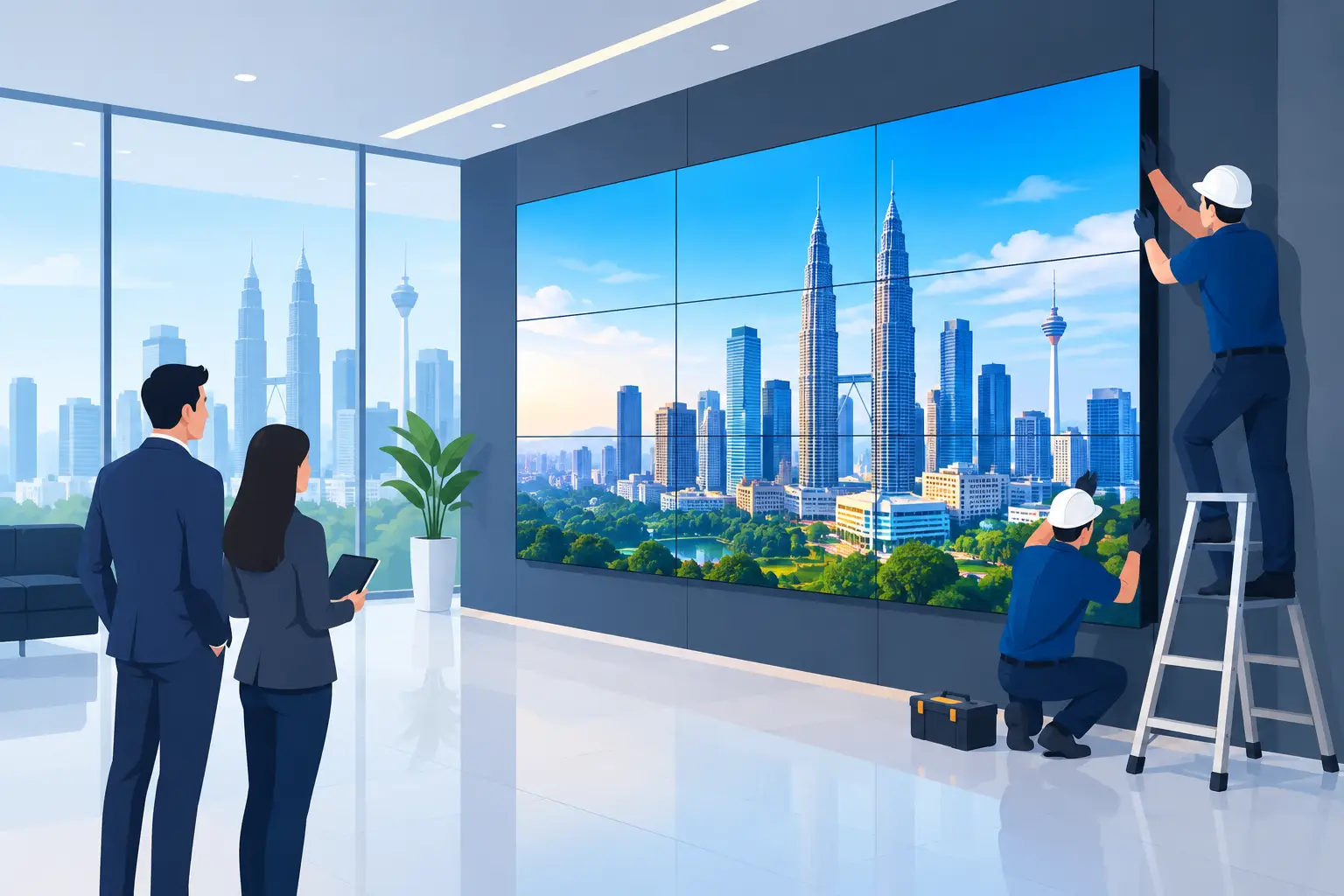
LED Video Wall Installation Malaysia for Business
A video wall that looks impressive in a supplier demonstration can disappoint quickly when text is hard to read, colours are uneven, or maintenance requires taking down an entire display. For organisations planning an LED video wall installation Malaysia, the real decision is not simply screen size. It is how the display will perform in its actual space, support its users and remain dependable after handover.
For a boardroom, training centre, reception area or command environment, an LED wall should make communication clearer. That outcome depends on sound planning before the first cabinet is mounted.
Start with the room, not the screen
The right LED display begins with the viewing environment. A reception display may need to catch attention from across an open lobby, while a boardroom wall needs to show spreadsheets, presentation text and video calls at close range. These are different requirements, even if the wall dimensions are similar.
A proper site survey should examine viewing distance, wall size, ambient light, ceiling height, power availability, network access and the route for bringing equipment into the building. In Kuala Lumpur commercial towers, lift dimensions, loading-bay arrangements and permitted work hours can affect the installation plan as much as the display specification.
It is also worth considering who will operate the system. If reception staff need to update announcements, the content process should be straightforward. If the wall is used for executive presentations, it should connect reliably to the room’s meeting technology without staff having to change cables or alter display settings each time.
Viewing distance determines pixel pitch
Pixel pitch describes the distance between LED pixels. A smaller pitch gives a sharper image at closer distances, but it also increases cost. Selecting the finest available pitch is not always the best commercial decision.
For example, a wall viewed from several metres away in a lobby can often use a larger pixel pitch than a display intended for a compact boardroom. In close-viewing environments, a pitch that is too large can make fine text look rough and images appear segmented. In a large atrium, spending heavily on an ultra-fine pitch may deliver little visible benefit.
The useful question is: where will the nearest regular viewer stand or sit? That answer should guide the display design, alongside the type of content being shown.
Brightness and content must work together
Indoor LED walls need enough brightness to remain clear under office lighting and daylight, particularly near glazed façades. Excessive brightness, however, can be uncomfortable in meeting rooms and make long presentations tiring to watch. Dimming controls and sensible calibration matter.
Content quality matters just as much. A wide LED wall will not improve low-resolution images, poorly formatted slides or small text designed for a laptop. Organisations should agree the main use cases early: corporate messages, product videos, dashboards, training material, live camera feeds or presentations. This helps determine the wall’s proportions, resolution and input configuration.
What a complete LED video wall installation Malaysia should include
An LED wall is a workplace system, not a boxed product. The installation must account for the display, mounting structure, controllers, power distribution, cabling, source devices and day-to-day operation. When these elements are supplied by separate parties, faults can become difficult to diagnose and responsibility can become unclear.
A complete project should begin with consultation and site assessment, followed by a proposed design that explains the display size, pixel pitch, mounting method and connectivity. It should also establish how the wall will be used with existing room equipment, whether that is a video-conferencing system, wireless presentation device, media player or digital-signage platform.
Installation should cover safe mounting, cable management, display alignment, controller configuration and image calibration. The final wall needs to be checked under normal room conditions, not only switched on briefly during commissioning. Fine differences in module alignment or colour uniformity become obvious on large blocks of colour and corporate branding.
User training is equally practical. Staff should know how to select common inputs, adjust appropriate settings, restart the system safely and identify when support is needed. A complicated system that only one technical employee understands is a risk for a busy organisation.
Mounting and service access are critical
LED cabinets require a supporting structure designed for the wall, the building surface and the chosen maintenance approach. Depending on the location, technicians may need front access or rear access to replace modules and inspect components. This should be decided before the wall is built into joinery or architectural finishes.
A flush, built-in installation can look highly professional in a customer-facing environment. It may also require more planning for ventilation, access panels and future servicing. A wall-mounted solution can be more straightforward to maintain, but its visual impact depends on clean finishing and disciplined cable routing.
There is no single best arrangement. The appropriate option depends on the room, the desired finish and the organisation’s tolerance for future access work.
Plan for reliability after opening day
A reception wall that fails before a client event, or a training display that cannot accept a presenter’s source, creates an immediate operational problem. Reliability comes from suitable equipment, correct installation and accountable local support.
Before approving a proposal, decision-makers should clarify the warranty scope, response process and availability of replacement parts. Ask who will handle the issue if a module fails, an input stops working or content is not appearing correctly. A single accountable partner can reduce the time spent coordinating between display suppliers, electricians, fit-out contractors and IT teams.
Preventive maintenance also has value for displays used continuously or in high-visibility areas. Periodic checks can identify loose connections, performance drift, ventilation concerns and early signs of component failure before they affect an important meeting or public-facing display.
For organisations with several branches, standardising the user experience is often more valuable than choosing different display models for each site. Similar controls, documentation and support arrangements make it easier for teams to operate the technology confidently.
Budget for the full project, not only the panels
LED video wall pricing varies widely because size and pixel pitch are only part of the scope. The supporting frame, processors, electrical works, data cabling, wall preparation, delivery logistics, installation access and after-sales coverage can all influence the final investment.
A lower headline price may exclude items required to make the display usable. Conversely, a more complete package can provide a clearer route to commissioning, training and support. Procurement teams should compare proposals based on what is included, the expected performance in the space and the responsibility for the finished system.
It is sensible to allow for content creation and management too. A visually strong LED wall needs a regular programme of relevant material. For a corporate reception, this might include visitor messages, business updates, safety information, event notices and brand content. For a training room, it may mean templates designed for the wall’s resolution and aspect ratio.
Choosing the right partner for the project
The most useful supplier will ask questions before recommending a display. They should want to understand the room, audience, content, existing technology, schedule and ongoing support expectations. A demonstration can be valuable, but it should be followed by a site-specific recommendation rather than a generic product quote.
Look for an implementation process that covers consultation, site survey, system design, installation, testing, user training, warranty and technical support. This gives facilities, IT and procurement teams a defined path from initial discussion to operational handover.
Hytech Office Automation supports Malaysian organisations with this end-to-end approach, helping teams assess LED displays alongside meeting-room and workplace technology rather than treating the wall as an isolated purchase. A showroom Experience Tour can also help stakeholders compare display options and consider the user experience before committing to a project.
The best LED wall is the one employees can use without hesitation and visitors can understand at a glance. Start with the room and the business purpose, then choose an installation plan that keeps the display clear, serviceable and ready for the next important message.