Copier Maintenance Contract Malaysia Buying Guide
A copier that stops working at 10.00am can hold up invoices, contracts, training packs and day-to-day administration before lunch. A suitable copier maintenance contract Malaysia businesses can depend on is not simply an add-on to a machine purchase. It is the service arrangement that keeps a critical office function available, predictable and properly supported when staff need it.
For office managers, IT teams and procurement leaders, the decision is rarely about finding the lowest monthly rate. It is about understanding what happens when print quality deteriorates, a paper-feed fault interrupts a busy department, or toner runs out during a client-facing deadline. The best contract sets clear expectations before those problems occur.
What a Copier Maintenance Contract Should Cover
Most copier maintenance agreements combine preventative servicing, fault repairs and the supply of selected consumables. The precise scope varies by provider and machine, so decision-makers should ask for each element to be stated clearly rather than assuming that “full maintenance” means everything is included.
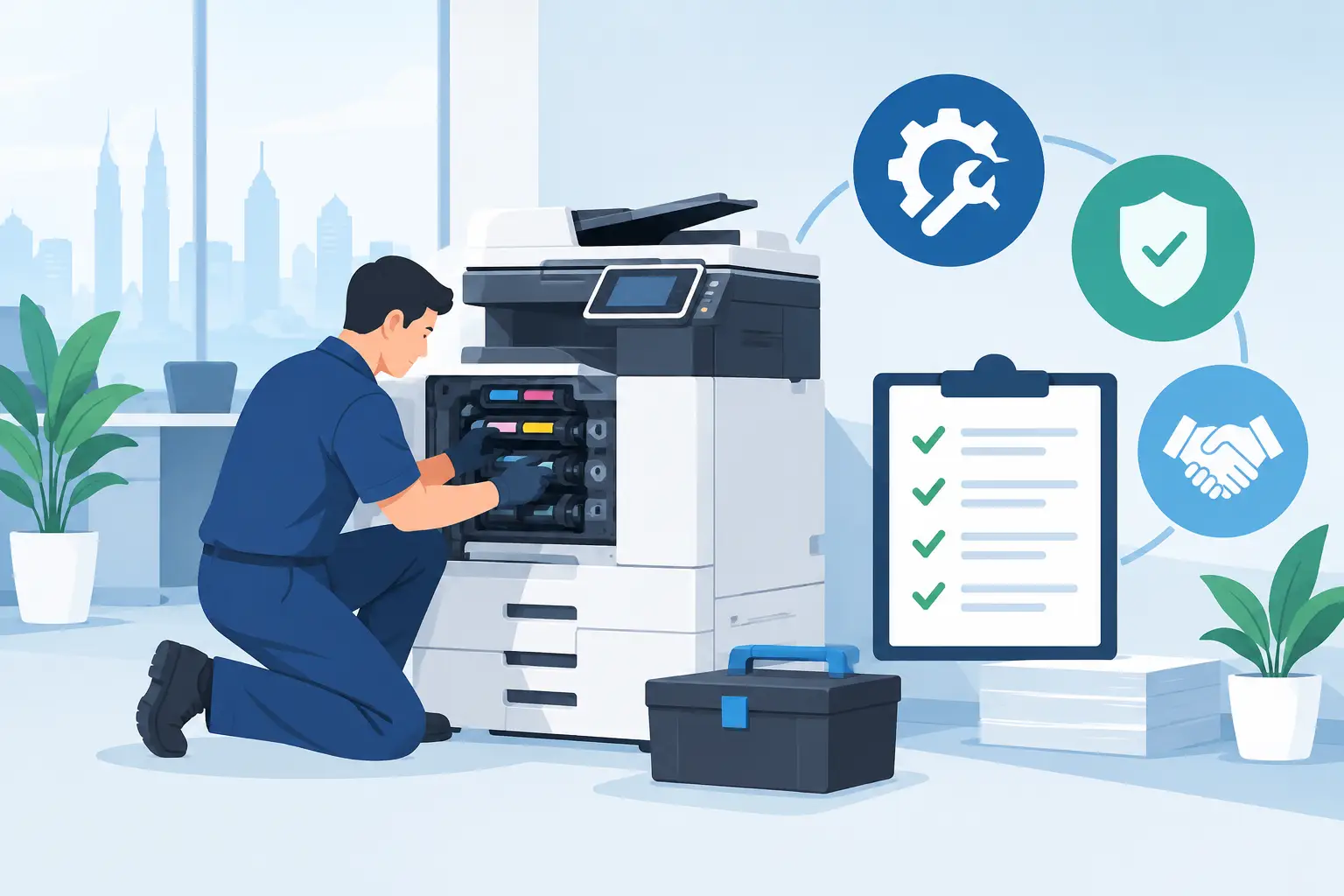
Preventative maintenance is the planned side of the arrangement. A technician inspects, cleans and adjusts components that wear through regular use, helping to prevent common faults before they cause downtime. This is particularly useful for organisations with high-volume printing, multiple departments or machines that handle different paper sizes and finishing requirements.
Breakdown support covers the unplanned issues: paper jams that persist, error codes, poor image quality, scanning faults or mechanical failures. A dependable provider should have trained technicians, access to appropriate parts and a defined process for logging and escalating calls.
Consumables are where contracts often differ. Toner is commonly included, while paper is normally not. Some agreements also include drums, developers, fuser units and other consumable parts. Others charge for particular items separately. Ask which components are included in the per-page price and which are considered chargeable exclusions.
Why Response Times Matter More Than a Low Headline Price
A maintenance contract is only valuable if it restores normal operations within a timeframe your business can tolerate. A small office with a secondary printer may manage for a day. A legal team preparing bundles, a school producing assessment materials or a healthcare administration department processing forms may not.
Look beyond a general promise of “fast service”. The agreement should explain the service area, operating hours, target response time and whether the target means an engineer has acknowledged the call, attended site or completed the repair. These are very different commitments.
For businesses in Kuala Lumpur and Selangor, local technical coverage can make a meaningful difference. A provider with technicians, spare parts and service coordination in the region is better placed to respond than a supplier relying on ad hoc third-party support. However, rapid attendance alone is not enough. The provider also needs the authority, stock and technical knowledge to diagnose the issue properly and resolve it without repeated visits.
If your organisation has a high dependence on one device, ask about contingency arrangements. This could include priority support, a loan unit in specific circumstances, or a replacement process when repair is no longer commercially sensible. Not every business needs these provisions, but they are worth considering where printing delays affect revenue, compliance or customer service.
Copier Maintenance Contract Malaysia: Questions to Ask Before Signing
A clear proposal should be easy to compare, even when suppliers structure their pricing differently. Before approving a contract, confirm these practical points:
- What is included in the monthly minimum, and what is the per-page charge for black-and-white and colour output?
- Are toner, replacement parts, labour, travel and routine servicing included?
- What response and resolution targets apply during your working hours?
- Are there exclusions for misuse, power damage, network changes, third-party consumables or non-standard media?
- How are meter readings collected, invoiced and checked against actual usage?
- What happens at contract end, when print volumes change, or when the copier is replaced?
The monthly minimum deserves careful attention. Many agreements include a set number of prints or copies each month, with additional pages charged separately. A low minimum can appear attractive but may lead to higher overage charges for busy teams. Conversely, paying for a very high allowance wastes budget if the office has moved towards digital approval workflows and prints less than before.
Review at least six to 12 months of actual usage where possible. Separate colour and monochrome output, and identify seasonal peaks such as enrolment periods, audits, board meetings or campaign production. This gives the provider a realistic basis for recommending a machine and service plan rather than relying on a rough estimate.
Understand the Difference Between Warranty and Maintenance
A manufacturer warranty and a maintenance contract serve related but different purposes. A warranty generally protects against defects for a defined period and may have conditions around usage, installation and authorised servicing. It does not always provide the ongoing consumables, routine maintenance or response commitment required for a busy office.
A maintenance contract is designed around continued operation. It provides a structured route for service requests and usually aligns the supplier’s support with the copier’s expected workload. For leased or rented equipment, maintenance may be bundled into the wider arrangement, but it should still be checked independently. Do not assume that a finance agreement automatically covers every repair or consumable.
Older devices need particular scrutiny. A contract can extend useful life where the machine remains suitable for your volume and document requirements. Yet if parts are becoming difficult to source, recurring call-outs are increasing or the device no longer supports secure printing and modern scan workflows, replacement may offer better value than maintaining ageing equipment indefinitely.
Match the Contract to How Your Teams Actually Work
The right support plan starts with the workplace, not the brochure specification. A compact office that mostly scans and occasionally prints presentations has different needs from a multi-floor organisation producing large volumes of invoices, HR documents and colour marketing materials.
Consider where documents enter and leave the business. If staff frequently scan to email, shared folders or document-management platforms, support should extend to the relevant device configuration and user guidance. If confidential material is printed in shared areas, secure-release settings and access controls should be reviewed as part of the broader print environment.
It also helps to identify ownership. The office administrator may manage toner requests, IT may handle connectivity and finance may approve invoices. When responsibilities are unclear, small issues can become prolonged interruptions. A service provider that can advise on setup, train users and provide a single accountable support route reduces that friction.
Hytech Office Automation supports organisations with copier solutions alongside installation, user training and local after-sales service. This broader approach can be useful when a copier sits within a wider workplace upgrade involving meeting rooms, display systems or connected document workflows.
Watch for Costs That Are Not Obvious at First
Transparent pricing protects both the customer and supplier. Ask whether rates are fixed for the full term or subject to annual review, and whether black-and-white and colour pages are counted differently. Clarify how A3 output, scans, fax functions, finishing accessories and unusually heavy paper are treated.
There may also be charges for moving equipment, reconfiguring network settings after an office relocation, repairing damage caused by unsuitable paper, or servicing devices that have been modified without approval. These are not necessarily unreasonable exclusions, but they should not come as a surprise after a service call.
Equally, consider the administrative cost of a poorly designed agreement. Manual meter readings, unclear invoices and separate contacts for toner and repairs consume staff time. Automatic meter monitoring and a defined replenishment process can make everyday management much easier, provided the organisation is comfortable with the relevant connectivity and data arrangements.
Build Service Reviews Into the Relationship
A copier contract should not be filed away and forgotten. Periodic reviews allow the provider and customer to identify changing volumes, repeated faults, unused functions and opportunities to improve workflow. If a department prints large packs only because scanning processes are inconvenient, the answer may be configuration or training rather than a larger copier.
Keep a simple record of recurring issues, call-out frequency and periods of disruption. This gives your team evidence when discussing service performance and helps determine whether the current machine remains fit for purpose. It also encourages a more productive conversation than judging the contract only by its monthly cost.
A worthwhile maintenance agreement gives your organisation confidence that printing will be available when work depends on it. Choose one with clear coverage, realistic response commitments and a local partner prepared to take responsibility throughout the equipment lifecycle.